
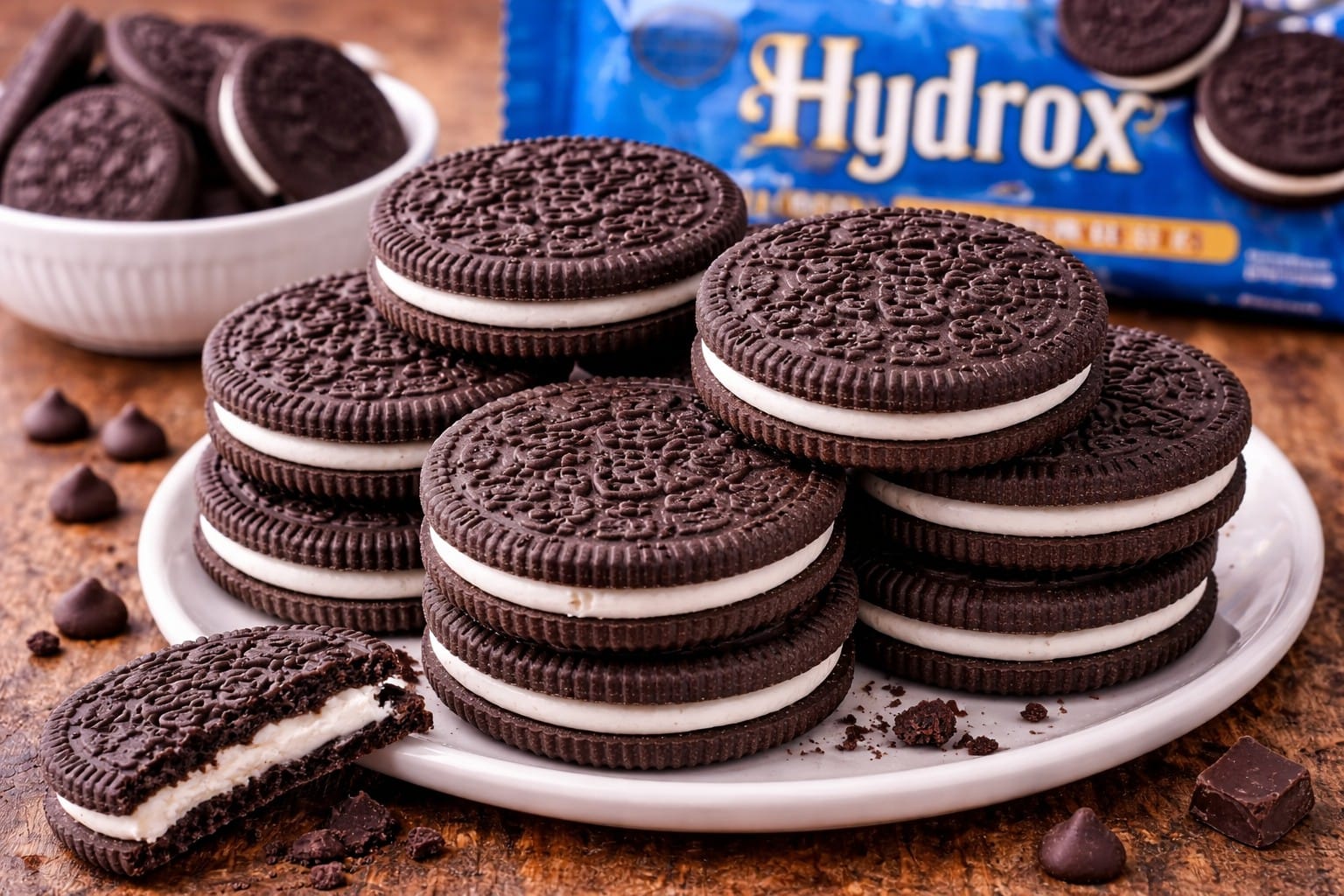
Here’s something that will bother you once you know it: Oreo is not the original chocolate sandwich cookie. Hydrox is. It came first by four years. And yet, walk into any grocery store today and you’ll find Oreo taking up an entire shelf section while Hydrox is nowhere to be seen. How does the original become the knockoff? That question is the whole story of Hydrox cookies — and it’s a stranger, more interesting story than most people expect.
This article covers everything you need to know about Hydrox cookies: what they are, where they came from, why they lost, why they came back, and whether they’re actually worth eating.
What Are Hydrox Cookies?
Hydrox is a creme-filled chocolate sandwich cookie — two dark chocolate wafers with white cream filling in the middle. If you’ve seen an Oreo, you know what Hydrox looks like. They’re almost identical at a glance. But they’re not the same cookie.
The wafer on a Hydrox has a stronger, more pronounced chocolate flavor. The cream filling is less sweet and a little thinner than Oreo’s. The whole cookie is crunchier and holds together better, which makes it noticeably more resistant to getting soggy when you dip it in milk. And unlike Oreo, Hydrox is made with real cane sugar — no high-fructose corn syrup, no artificial flavors, no hydrogenated oils. It’s been non-GMO certified since 2017.
Today, Hydrox is owned and made by Leaf Brands, a small California company that brought the cookie back in 2015 after it had been off the market for over a decade. It’s still being made and sold — mostly online, and in select stores — though it’s a fraction of the size of Oreo in terms of reach and availability.
The History of Hydrox Cookies
1908: The Beginning
Hydrox was created in 1908 by the Loose-Wiles Biscuit Company, a Kansas City business that would later become known as Sunshine Biscuits. The founders, Jacob and Joseph Loose, had built a regional baking empire and were looking for a signature product. What they came up with was a chocolate wafer sandwich with cream filling — something nobody had done before on a commercial scale.
The name came from hydrogen and oxygen, the two elements in water. The idea was purity. At the time, baked goods were often adulterated with chalk, plaster of Paris, and other fillers. Sunshine wanted Hydrox to stand apart, and they marketed it hard on that angle — “thousand window” factories with natural light, chemists testing batches for purity, clean ingredients. The cookie was billed as the “aristocrat of cookies,” and it worked. Hydrox became a genuine hit.
The name, though, was always a problem. “Hydrox” sounds clinical. It sounds like something you’d use to disinfect a wound, not something you’d eat with a glass of milk. There was even a real Hydrox Chemical Company at the time, selling hydrogen peroxide. Customers were sometimes confused. The name never had the warmth or memorability that a food brand needs.
1912: Oreo Arrives
Four years after Hydrox launched, Nabisco introduced the Oreo cookie on April 2, 1912. It was one of three cookies Nabisco released that day — the other two, the Mother Goose biscuit and the Veronese biscuit, no longer exist. Oreo survived.
Oreo was modeled directly on Hydrox. Same concept: chocolate wafers, cream filling, round shape. But Nabisco had deeper marketing resources and a better name. “Oreo” is short, easy to say, and sounds like food. Nabisco pushed it hard with national advertising while Sunshine worked to hold its ground.
For a while, the two cookies genuinely competed. But the tide started turning in the 1950s. When Nabisco raised the price of Oreo, rather than customers choosing the now-cheaper Hydrox, they avoided it — seeing it as a lesser product, a budget option. That perception, once settled, never fully left. By mid-century, Hydrox was seen as the knockoff, even though it was the original. That’s one of the more remarkable reversals in American consumer product history.
The Kosher Advantage That Wasn’t Enough
For decades, Hydrox had one real advantage over Oreo: it was kosher. The original Oreo recipe used lard in the cream filling, making it off-limits for observant Jewish households. Hydrox, always made without animal fats, filled that gap. It was the sandwich cookie in Jewish homes across America for generations.
The Carvel ice cream chain leaned on this for years, using Hydrox crumbs in their products specifically because of the kosher certification. They only switched to Oreo after 2012, once Oreo had long since removed the lard and obtained kosher status. By then, Hydrox’s unique advantage in that market had eroded.
1996–2003: How Corporate Neglect Killed It
Sunshine Biscuits was acquired by Keebler in 1996. Three years later, Keebler discontinued Hydrox and replaced it with a reformulated product called Droxies — a sweeter, changed version that didn’t satisfy loyal fans. Then Kellogg’s acquired Keebler in 2001 and pulled Droxies off shelves in 2003 entirely. Hydrox was gone.
There was one brief flicker. In 2008, on the cookie’s 100th anniversary, Kellogg’s brought Hydrox back under the Sunshine label in response to genuine fan pressure — over 1,300 phone calls, an online petition, a dedicated fan website. Hydrox was back nationally for a few months. Then Kellogg’s quietly removed it from their website and let the trademark lapse. The fans who had lobbied for its return were left with nothing.
2015: The Real Comeback
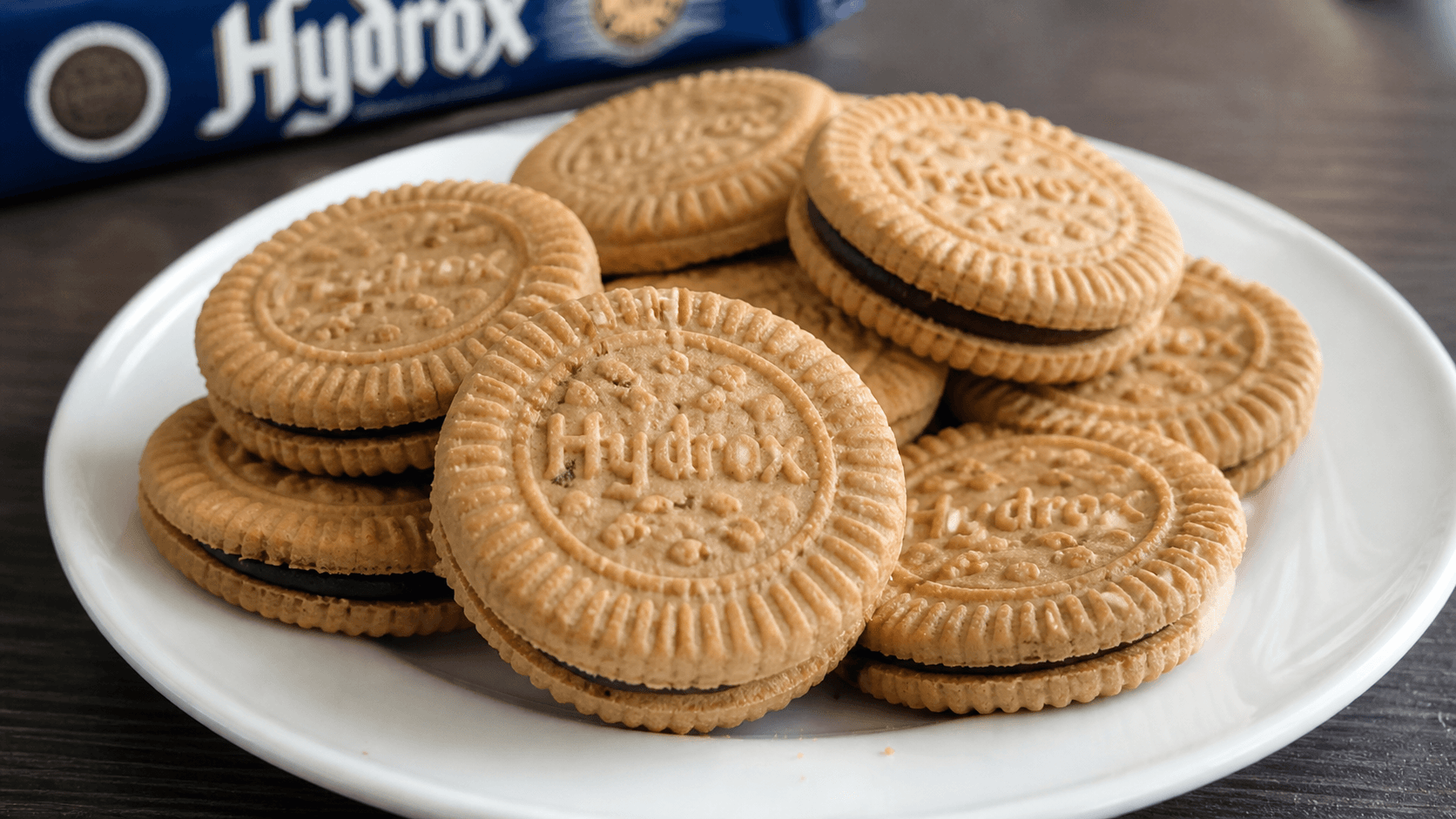
Ellia Kassoff grew up in a Jewish household where Hydrox was the only sandwich cookie allowed. When he discovered Kellogg’s had abandoned the trademark, he saw an opening. Under US trademark law, a brand goes into the public domain if it isn’t used for three years. With the trademark available, Kassoff applied for it through his company, Leaf Brands.
Getting the trademark was one challenge. Getting the recipe was another. Kassoff didn’t have the original formula. So he tracked down an unopened 1998 box of Hydrox on Craigslist, brought in a food scientist, and reverse-engineered the recipe from scratch. He recruited fans as taste testers to make sure it matched what people remembered. “If it’s not exactly the way they remember it, you’ll get one sale,” he said.
Leaf Brands started production on September 4, 2015, in Vernon, California. And they didn’t stop there — in 2017, they cleaned the recipe further. High-fructose corn syrup was out, replaced with real cane sugar. Hydrogenated oils were removed. Artificial flavors that had been in the recipe for 50 years were cut. Hydrox became non-GMO certified. The revived cookie was, in some ways, better than the original had been.
Hydrox vs. Oreo: What’s Actually Different?
Most people who’ve never tried Hydrox assume it’s basically Oreo with different packaging. That’s understandable — they look nearly identical. But if you do a side-by-side taste test, the differences are clear.
The chocolate flavor in Hydrox hits harder. Oreo uses Dutch-process cocoa, which is alkalized to reduce bitterness and produce a milder, smoother chocolate taste. Hydrox goes closer to natural cocoa, which means the chocolate flavor is more intense and more recognizable as chocolate. For people who eat Oreo and think it tastes more like sweet than chocolate, Hydrox tends to come as a pleasant surprise.
The filling is where the biggest difference shows up for most people. Oreo’s creme is thick, very sweet, and tends to dominate the cookie. Hydrox’s filling is thinner and less sweet — the cookie and the cream balance each other rather than the cream overwhelming everything. If you’ve ever eaten an Oreo and thought “this is too sweet,” Hydrox is likely more your speed.
Then there’s texture. Hydrox is noticeably crunchier. The wafer is denser and holds together better. This matters most if you dip your cookies in milk — Hydrox stays firm significantly longer than Oreo, which softens quickly. For serious milk-dunkers, this is actually a meaningful difference.
On ingredients, Hydrox comes out ahead for anyone reading labels. Oreo contains both sugar and corn syrup, putting total sugar at 14g per serving. Hydrox uses only cane sugar and comes in at 12g. Hydrox has no artificial flavors; Oreo still uses them. Hydrox is non-GMO certified; Oreo is not. Neither cookie is a health food, but if ingredients matter to you, Hydrox is the cleaner option.
Why Hydrox Lost — and What It Tells Us About How Brands Work
Hydrox didn’t lose to Oreo because it was an inferior product. It lost because of marketing, naming, and a series of corporate decisions that had nothing to do with the cookie itself.
The name did real damage from the start. A food brand needs a name that feels warm, inviting, and easy to remember. Hydrox has none of those qualities. It sounds industrial. It sounds chemical. Even in 1908, there were concerns about the name — and those concerns were valid. Oreo, by comparison, is simple and pleasant. You can say it without thinking about it. Hydrox makes people stop and wonder what they’re eating.
But the deeper issue was marketing muscle. Nabisco was a significantly larger company than Sunshine Biscuits, and they spent accordingly. Oreo got national campaigns, memorable advertising, and consistent brand building over decades. Hydrox got solid advertising in the early years but couldn’t match Nabisco’s scale.
The pricing mistake of the 1950s compounded everything. When Nabisco raised Oreo’s price, economists would predict consumers should move toward the cheaper alternative. Instead, they moved away from Hydrox. People read “cheaper” as “worse,” and the perception of Hydrox as the budget knockoff cemented itself in the public mind — even though Hydrox had been there first.
Then came the corporate carousel. Hydrox went from Sunshine to Keebler to Kellogg’s across a few years, with each new owner caring less about it than the last. Brand continuity disappeared. By the time it went off shelves in 2003, an entire younger generation had grown up without ever seeing it.
The result is one of the stranger ironies in American food history: the original chocolate sandwich cookie is widely seen as the cheap imitation of the cookie it inspired.
The Shelf War: Hydrox vs. Mondelez
The rivalry between Hydrox and Oreo didn’t stay polite. In 2018, Leaf Brands filed a formal complaint with the US Federal Trade Commission, accusing Mondelez International — the company that makes Oreo — of deliberately hiding Hydrox cookies from customers on store shelves. The claim was that Oreo representatives were physically repositioning Hydrox products to less visible spots or blocking them with Oreo packaging.
Whether or not the FTC complaint led to any formal action, it highlighted a real problem Hydrox faces: shelf real estate in grocery stores is controlled by companies with buying power, and Mondelez has vastly more of it than Leaf Brands. Getting Hydrox onto shelves — and keeping it visible once it’s there — is an ongoing battle that Leaf Brands has limited tools to fight.
In 2018, Kroger dropped Hydrox from its stores. The combination of limited shelf presence and low consumer awareness has kept Hydrox as a niche product despite the genuine quality of the cookie and the genuine loyalty of its fans.
Where to Buy Hydrox Cookies
Finding Hydrox in a physical grocery store takes some effort. It’s not stocked in most major chains the way Oreo is. Your best options in 2025 are online. Amazon carries Hydrox in both single packages and multi-packs, and it’s the most consistently reliable place to order. Walmart.com stocks it for shipping even when physical Walmart locations don’t carry it on shelves. You can also order directly from Leaf Brands at their website.
For physical retail, Cracker Barrel has been one of the most dependable brick-and-mortar locations. Some regional grocery chains and specialty food stores carry it as well. If you want to find it locally, calling your grocery store ahead of time saves a wasted trip. Leaf Brands has a store locator on their site that can help narrow things down.
Frequently Asked Questions About Hydrox Cookies
Are Hydrox cookies still being made?
Yes. Hydrox is currently in production by Leaf Brands. The cookie came back in September 2015 and has been available since, primarily through online retailers and select physical stores.
Did Hydrox come before Oreo?
Yes. Hydrox launched in 1908. Oreo launched in 1912, four years later. Oreo was modeled on Hydrox, not the other way around — though most people today believe the opposite.
Are Hydrox cookies kosher?
Yes. Hydrox has always been kosher. The original Oreo recipe used lard in the cream filling, which made it non-kosher for decades. Hydrox was always free of animal fats and remains kosher today. It also carries an OU Kosher (DE) certification and is vegan.
Are Hydrox cookies healthier than Oreo?
Neither cookie is a health food, but Hydrox has a cleaner ingredient list. It uses real cane sugar instead of corn syrup, contains less total sugar per serving (12g vs 14g in Oreo), has no artificial flavors, no hydrogenated oils, and is non-GMO certified. If you’re comparing labels, Hydrox comes out ahead.
Do Hydrox cookies taste like Oreo?
They’re similar but noticeably different in a side-by-side comparison. Hydrox has a stronger chocolate flavor and a less sweet filling. The wafer is crunchier. Overall it’s a less sweet, more chocolate-forward cookie. People who find Oreo too sweet often prefer Hydrox. People who love Oreo’s sweetness may find Hydrox underwhelming by comparison.
Why did Hydrox disappear?
Hydrox was discontinued in 1999 after Sunshine Biscuits was acquired by Keebler. Keebler replaced it with a reformulated product called Droxies, which was later dropped after Kellogg’s acquired Keebler in 2001. A brief relaunch happened in 2008 for the cookie’s 100th anniversary, but it was short-lived. Kellogg’s eventually abandoned the trademark, which allowed Leaf Brands to claim it and bring Hydrox back in 2015.
Where can I buy Hydrox cookies?
The easiest place is Amazon. Walmart.com also carries it for shipping. Cracker Barrel is one of the most reliable physical retail locations. You can also order directly through the Leaf Brands website. Availability in regular grocery stores is limited and varies by region.
Final Word
Hydrox cookies are one of those products where the actual story is completely different from the public perception. Most people who know the name at all assume it’s a cheap Oreo imitation. It’s the opposite — Oreo imitated Hydrox, then beat it through better marketing and a better name.
What Leaf Brands has done since 2015 is straightforward: bring the cookie back with cleaner ingredients and let it stand on its own. It’s less sweet, crunchier, and made with simpler ingredients than Oreo. Some people will prefer it. Some won’t. But it’s a genuinely different cookie with a legitimate claim to being the original — and for a lot of people, that’s enough reason to try it at least once.
If you grew up eating Hydrox before 1999, you already know whether you want them back. And if you’ve never tried one — they’re worth finding.